CBD vs THC: Which One Should You Vape? (The Truth About Effects, Legality & Getting What You Actually Need)
14 min read
Understanding the differences between CBD and THC matters if you’re making decisions about what to vape, what effects you want, and what’s actually legal where you live. These two cannabinoids come from the same plant family but work differently in your body and carry distinct legal classifications across most regions.
I spent years vaping THC products recreationally before trying CBD for sleep issues, and the contrast was striking. THC delivered that familiar euphoric high and occasional anxiety spike, while CBD offered relaxation without any intoxication. That personal experience mirrors what the science shows: THC binds directly to cannabinoid receptors in your brain, creating psychoactive effects, while CBD interacts with your endocannabinoid system indirectly, producing therapeutic benefits without the high.
The legal landscape remains messy in 2026. THC products face restrictions in many jurisdictions, while CBD derived from hemp (containing less than 0.3% THC) enjoys broader legal acceptance. But laws vary dramatically by location, and enforcement isn’t always consistent with legislation.
Some people report that CBD helps with anxiety, inflammation, and sleep difficulties, though you should consult a healthcare provider before using it to address any medical condition. THC proponents point to potential benefits for pain and nausea, but again, medical supervision is essential. Neither compound is FDA-approved for treating specific conditions outside of a few prescription medications.
This guide breaks down how these cannabinoids differ in effects, legality, safety profiles, and practical vaping applications. Whether you’re exploring options for the first time or reconsidering your current routine, understanding CBD versus THC helps you make informed choices.
The Core Difference: What CBD and THC Actually Do to Your Body
Here’s the thing about CBD and THC that trips up most people, including me when I first started vaping cannabis products: they come from the same plant, but your body treats them like completely different substances. I learned this the hard way after confidently vaping a high-THC cartridge at a friend’s place, expecting the gentle relaxation I’d felt with CBD. Twenty minutes later, I was locked to the couch, overthinking every conversation I’d had that week. That experience taught me what the science confirms: these two cannabinoids plug into your body’s systems in fundamentally different ways.
Your body has what scientists call the endocannabinoid system, a network of receptors spread throughout your brain, organs, and tissues. Think of it like a lock-and-key system. THC is a key that fits perfectly into CB1 receptors concentrated in your brain and central nervous system. When THC binds to these receptors, it directly activates them, triggering the psychoactive effects everyone associates with getting high: altered perception, euphoria, and yes, that couch-lock I experienced.
CBD takes a completely different approach. Rather than directly activating CB1 receptors, CBD modulates CB1 activity and interacts with various other receptors throughout your body. It influences how these systems work without creating intoxication. This is why you can vape CBD during your lunch break and return to work without impairment.
| Attribute | CBD | THC |
|---|---|---|
| Psychoactive Effect | Non-intoxicating | Produces euphoria and altered perception |
| Legal Status Overview | Widely available in many jurisdictions | Restricted; legal only in specific regions |
| Typical Uses | Relaxation support, wellness routines | Recreation, reported therapeutic applications |
| Onset When Vaped | 5-10 minutes | 2-5 minutes |
| Duration of Effects | 2-4 hours | 2-6 hours depending on dose |
The molecular structure difference between these compounds might seem minor on paper, but that small variation determines whether you feel relaxed and clear-headed or completely stoned. CBD has a hydroxyl group where THC has a cyclic ring, and that tiny distinction changes everything about how your brain processes the compound. This structural difference explains why THC shows up on drug tests while CBD typically does not, and why driving after vaping THC can get you a DUI while CBD won’t.
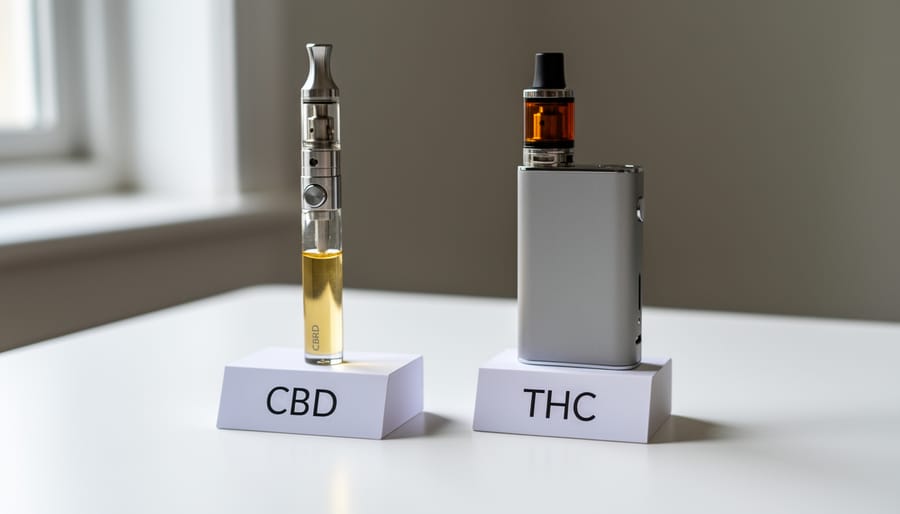
Effects You’ll Actually Feel: CBD vs THC When Vaping
What CBD Vaping Feels Like (and What It Doesn’t)
Most people I’ve talked to describe CBD vaping as a gentle settling sensation rather than anything dramatic. Within a few minutes of inhaling, users report feeling physical tension ease without any mental fog or altered perception. Some say it takes the edge off anxious thoughts, while others notice their shoulders drop from around their ears for the first time all day. The key word here is subtle, if you’re expecting something you can point to and say “there it is,” you might think nothing happened at all.
Here’s what CBD absolutely does not do: it won’t get you high, period. There’s no euphoria, no giggles, no munchies, and no couch-lock. Research confirms that CBD does not impair driving or cognitive function the way THC does. You can vape CBD before work, before picking up your kids, or before any activity requiring full mental clarity.
Users report various wellness applications, some find it helps them unwind after stressful days, others mention using it for workout recovery or sleep support. That said, if you’re dealing with specific health conditions, you should consult a healthcare provider rather than self-treating with CBD. These are personal experiences people share, not medical treatment protocols.
The bottom line: CBD is for those wanting potential relaxation benefits without psychoactive effects or impairment.
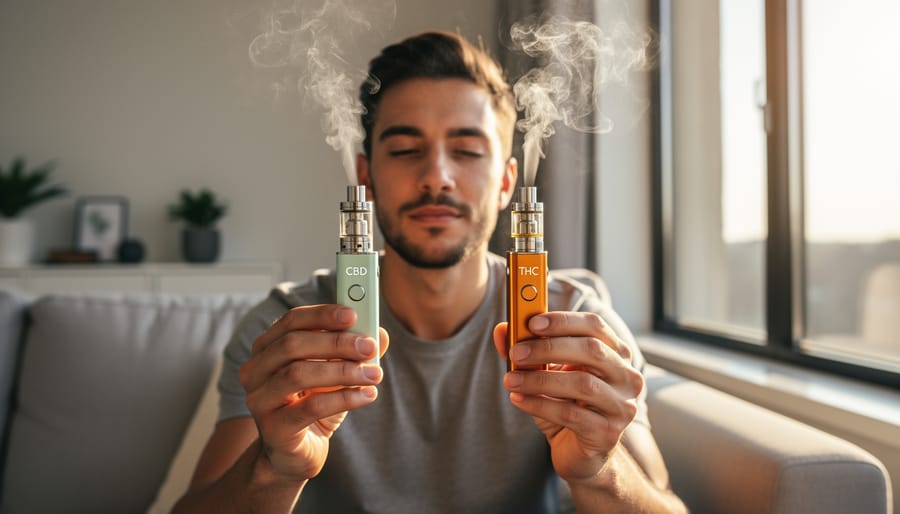
THC Vaping Effects: The Full Picture
THC’s effects arrive quickly when vaped, typically within minutes. Most users report an initial wave of euphoria, a sense of relaxation that spreads through the body, and a noticeable shift in how time feels. Colors might seem more vivid, music more layered, conversations more absorbing. Your thoughts can wander in unexpected directions, sometimes productively creative, other times just pleasantly scattered.
The intensity varies wildly between people and products. A low-dose THC vape might produce mild relaxation and gentle mood elevation, while higher concentrations can lead to pronounced psychoactive effects including altered perception, increased appetite, and in some cases, anxiety or paranoia, especially in new users. I’ve watched friends giggle uncontrollably at nothing while others became quiet and introspective from the same cartridge.
Some users report THC helps them unwind after stressful days, supports appetite, or aids sleep, though these are personal experiences rather than medical claims. If you’re considering THC for health reasons, consult a healthcare provider first, particularly if you’re on medications or managing specific conditions.
THC impairs coordination and judgment, so never drive or handle machinery while affected. Start with minimal doses if you’re new, and understand that legal THC alternatives exist with varying potency levels. Your experience will depend on the strain, your tolerance, your setting, and your individual body chemistry, which is why what works perfectly for one person might overwhelm another.
Legal Landscape in 2026: Where You Stand with CBD and THC Vapes
Cannabis Act Framework: What Canadian Vapers Need to Know
Canada’s cannabis landscape changed fundamentally when the Cannabis Act in force took effect on October 17, 2018. This federal legislation created a strict legal framework controlling production, distribution, sale and possession of cannabis across the country, a framework that directly impacts every Canadian vaper choosing between CBD and THC products in 2026.
Here’s what matters for your vaping decisions: the initial legalization covered dried flower, pre-rolls, oils, tinctures and capsules. Vapes and cartridges followed exactly one year later, becoming regulated on October 17, 2019. If you’re shopping today, you’re buying products that have been under federal oversight for nearly seven years, which means quality controls and testing standards have had time to mature.
The Cannabis Act distinguishes clearly between hemp-derived CBD (legal with restrictions) and cannabis-derived products containing THC (fully regulated under the Act). When you walk into a licensed dispensary or browse an authorized online retailer, every vape product, whether CBD-dominant, THC-rich, or a balanced ratio, must meet the same production and distribution standards. Understanding basic vape terms helps you navigate product labels and COAs more confidently.
Today’s legal market includes the full spectrum: dried flower, edibles (gummies, baked goods, chocolates), concentrates (shatter, live resin, hash), and of course, vapes and cartridges. For Canadian vapers, this means legitimate access to tested, regulated products, but only through licensed channels. Purchasing outside this framework, despite lower prices, means zero guarantees about what’s actually in your cartridge.
Beyond Canada: Global Variations in CBD and THC Access
The legal landscape for CBD and THC products shifts dramatically once you cross borders or even state lines. What’s perfectly legal in one jurisdiction can carry serious penalties in another, which matters if you travel or order products internationally.
In the United States, the 2018 Farm Bill federally legalized hemp-derived CBD containing less than 0.3% THC, but individual states maintain their own regulations. Some states allow recreational THC sales through licensed dispensaries, others permit only medical cannabis with a prescription, and a few maintain complete prohibition. The patchwork creates confusion, especially for CBD products that may be legal federally but restricted locally.
Europe presents even more variation. The Netherlands tolerates cannabis use in coffee shops despite technical prohibition, while countries like Portugal have decriminalized possession for personal use. The United Kingdom permits CBD products but strictly prohibits THC. Many European nations allow CBD vapes if THC content remains below 0.2%, though enforcement and product availability differ widely.
In much of Asia and the Middle East, both CBD and THC remain illegal with harsh penalties. Australia requires prescriptions for both compounds, though regulations have loosened slightly in recent years. New Zealand legalized medicinal cannabis but rejected recreational use in a 2020 referendum.
The crucial takeaway: never assume your home jurisdiction’s laws apply elsewhere. Before traveling with vape products or ordering internationally, research specific regulations for your destination. Even CBD-only products can cause legal problems in countries with zero-tolerance cannabis policies. When in doubt, leave your vape at home rather than risk confiscation or worse.
Choosing Between CBD and THC Vapes: Your Decision Framework
Choosing which compound to vape isn’t about picking a winner, it’s about matching the product to what you actually need from it. I’ve watched too many friends grab whatever their buddy recommended, only to find themselves either disappointed by lack of effects or unexpectedly high when they needed to stay functional. Let me walk you through a framework that actually works.
Start with your primary goal. If you’re looking for relaxation or wellness support without any cognitive changes, CBD is your answer. Users report it helps them unwind without affecting their ability to work, drive, or handle responsibilities. If you’re seeking the classic cannabis experience, euphoria, altered perception, or that distinctive high, THC is what delivers that. Many wellness-focused users who consult their healthcare providers report finding relief with THC for specific concerns, though you should always discuss cannabis use with your doctor if you’re considering it for health reasons.
Your tolerance for psychoactive effects matters tremendously here. Be honest with yourself about whether you want or can handle feeling high. Some people love the THC experience recreationally but can’t incorporate it into their daily routine because of work drug testing, safety-sensitive jobs, or simply preferring to stay sharp. CBD offers an alternative within the various methods of consuming cannabis that doesn’t compromise your mental clarity.
That said, you don’t have to choose just one. Combined CBD:THC products offer different ratios that create distinct experiences:
- 1:1 Ratio
- Equal parts CBD and THC, providing a balanced effect where CBD may moderate THC’s intensity while both compounds work together. Users report a mellower high than THC alone.
- 2:1 CBD:THC
- Twice as much CBD as THC, offering subtle relaxation with minimal psychoactive effects. A popular choice for daytime use among those wanting slight THC benefits without significant impairment.
- 20:1 CBD:THC
- Heavily CBD-dominant with trace THC, delivering primarily CBD effects with potential entourage benefits. Essentially non-intoxicating for most users.
- 1:0 (CBD only)
- Pure CBD with no THC, ensuring zero psychoactive effects. Ideal for anyone subject to drug testing or simply wanting no THC whatsoever.
These ratios aren’t just marketing, they genuinely create different experiences. A 1:1 product will feel nothing like a 20:1, and understanding this helps you dial in what works for your situation.
Consider your lifestyle realistically. If you’re a parent picking kids up from school, a professional in client-facing meetings, or someone who needs to stay alert, CBD or high-CBD ratios make sense for daytime. THC fits better into evening relaxation or dedicated recreational time when you don’t need to be anywhere or do anything requiring coordination and judgment.
Product Quality Markers: What to Look for When Purchasing
I’ve walked through too many dispensaries where budtenders can barely explain what’s in the products they’re selling. During an interview last year with a dispensary owner in Vancouver, she told me the most common quality issue she sees is customers returning products with harsh throat hits from mystery carrier oils. “If they’d just checked the COA, they would’ve seen the terpene content was artificially boosted with cheap additives,” she said, shaking her head.
Whether you’re shopping for CBD or THC vape products, knowing what separates quality from garbage protects both your wallet and your lungs. Here’s what actually matters.
Start with third-party cannabis lab testing results. Any reputable brand publishes certificates of analysis (COAs) showing cannabinoid potency, residual solvents, pesticides, heavy metals, and microbial contaminants. These documents should be recent, batch-specific, and easily accessible through QR codes on packaging or the company website. If you can’t find a COA within two minutes of searching, walk away.
Check the extraction method. CO2 extraction and ethanol extraction produce cleaner concentrates than butane hash oil (BHO), though quality BHO exists when properly purged. The COA should show residual solvent levels below safety thresholds. Avoid products labeled “distillate” without further information since some cheap distillates strip away beneficial compounds and reintroduce synthetic terpenes.
Carrier liquids matter more than most people realize. For vape cartridges, look for products using MCT oil, hemp seed oil, or terpene-only formulations. Run from anything containing vitamin E acetate, which has been linked to serious lung injuries, or propylene glycol and vegetable glycerin in cannabis vapes (they’re fine for nicotine vapes but can degrade cannabinoids at high temperatures and produce harsh vapor).
Natural terpene profiles indicate quality. Real cannabis-derived terpenes provide entourage effects and smooth flavor. Generic “strain flavors” using botanical or synthetic terpenes work in a pinch but lack therapeutic synergy. The COA should list specific terpenes like myrcene, limonene, or pinene with actual percentages, not just “natural flavors.”
Red flags to avoid: prices significantly below market average, cartridges with no strain or batch information, packaging covered in unverifiable health claims, products from unlicensed sources, hardware that looks cheaply made with visible glue or plastic taste, and vague labeling like “pure” or “organic” without supporting documentation.
Trust licensed retailers over random online shops, especially for THC products where regulations ensure basic safety standards.
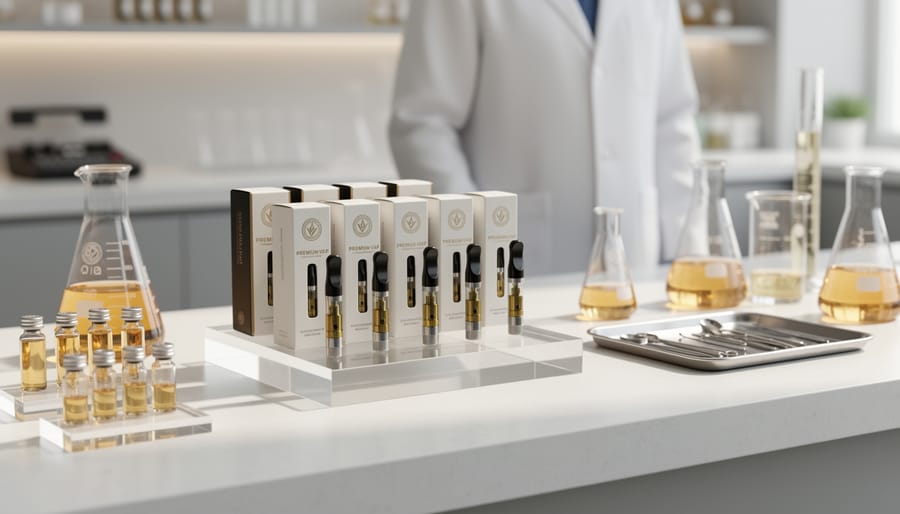
Where and How to Access Quality CBD and THC Vape Products
In Canada, your safest starting point is a licensed cannabis retailer, whether physical or online, all of which operate under Health Canada’s oversight. These dispensaries verify your age (19+ in most provinces, 18+ in Alberta and Quebec), provide detailed product information, and stock only products that have passed regulatory testing. For CBD specifically, you’ll find options through both licensed cannabis retailers and, where hemp-derived CBD is concerned, some health stores and online platforms, though buying CBD online requires checking that the seller complies with applicable regulations and provides third-party lab results.
When you visit a licensed dispensary, expect to show government-issued ID and to receive products in plain, child-resistant packaging with clear cannabinoid content labels. Staff can walk you through THC-to-CBD ratios, terpene profiles, and recommended starting doses, which is invaluable if this is new territory for you. Online purchasing through provincial platforms or licensed private retailers offers the same regulatory protections with home delivery, though shipping times vary.
Pricing reflects the regulatory framework and quality standards. A half-gram THC vape cartridge typically runs between $30 and $60, while CBD-dominant or balanced CBD/THC options fall in a similar range. Higher prices usually correlate with premium extraction methods, organic source material, or cannabis-derived terpenes rather than botanical ones. If a deal seems too good to be true, it probably involves cutting corners that compromise your safety. Regulated products cost what they do because they’re tested, traceable, and produced under strict oversight, money well spent when you’re inhaling something directly into your lungs.
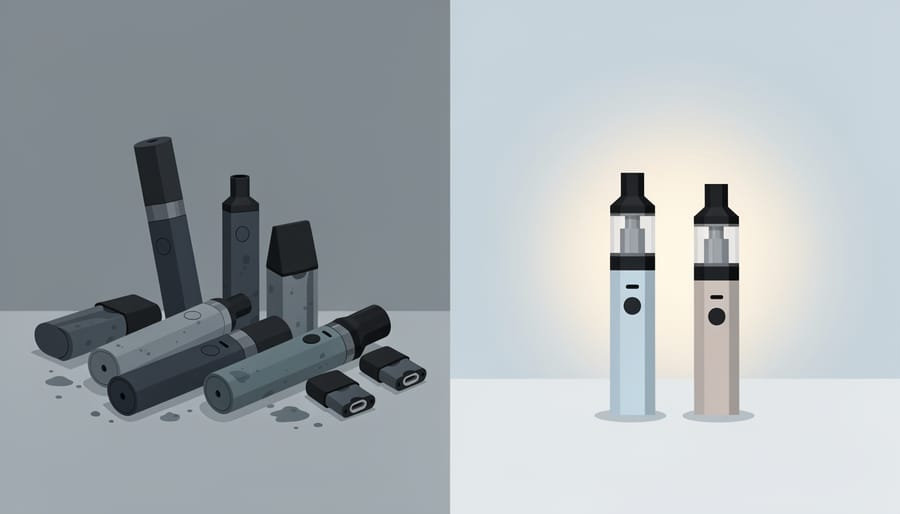
Safety Considerations Every Vape User Should Know
Whether you choose CBD or THC vapes, understanding basic safety practices protects your health and keeps your experience positive. I’ve seen too many newcomers rush into vaping without knowing the essentials, so let’s cover what actually matters.
Start low with dosing, especially if you’re new to vaping either compound. For CBD vapes, begin with one or two small puffs and wait 15 minutes to assess how you feel. THC requires even more caution since its psychoactive effects can overwhelm beginners. A single three-second draw is enough for your first time. You can always take more, but you can’t undo overconsumption.
Watch for adverse reactions. CBD rarely causes problems, but some people experience dry mouth, drowsiness, or changes in appetite. THC can trigger anxiety, paranoia, rapid heartbeat, or dizziness, particularly at higher doses. If you feel uncomfortably anxious or disoriented, find a safe, calm space and remember the effects will pass. Drinking water and having a snack often helps.
Never drive or operate machinery after using THC vapes, period. Even if you feel fine, your reaction time and judgment are impaired. CBD typically does not cause impairment, but if your product contains any THC or if you feel drowsy, apply the same caution.
If you take prescription medications or have health conditions, consult your healthcare provider before vaping CBD or THC. Cannabis compounds can interact with blood thinners, antidepressants, and many other medications. This isn’t optional advice, it’s essential for your safety.
Store your vapes properly. Keep them upright in a cool, dark place away from children and pets. Extreme heat degrades cannabinoids and can damage batteries. Clean your device regularly according to the manufacturer’s instructions. Residue buildup affects vapor quality and can harbor bacteria.
Device maintenance matters more than most people realize. Check your battery connections, replace coils when vapor production drops, and never use a damaged device. A cracked cartridge or malfunctioning battery creates real safety risks beyond just wasting your product.
Understanding the difference between CBD and THC isn’t just about knowing which cannabinoid gets you high. It’s about matching the right compound to your lifestyle, legal situation, and what you’re actually trying to achieve when you vape. CBD offers relaxation and reported wellness benefits without intoxication, making it accessible in many jurisdictions and compatible with daily responsibilities. THC delivers psychoactive effects that some users seek for recreation or specific wellness support, but it comes with legal restrictions and impairment considerations you can’t ignore.
Your choice ultimately hinges on three factors: what effects you need, what’s legally accessible where you live, and how those effects fit into your work and personal life. The decision framework and quality markers covered here give you the tools to navigate dispensaries and online retailers with confidence, distinguishing legitimate products from questionable ones. As cannabis regulations continue evolving in 2026, staying informed about both compounds puts you in control. Whether you choose CBD for its non-intoxicating profile, THC for its fuller spectrum of effects, or a balanced combination, you’re now equipped to make that decision based on real information rather than marketing hype or outdated assumptions.